
Ask most men how they’re doing, and the answer is usually “fine.” It’s automatic, almost reflexive, and it often isn’t true. Recognising the signs of poor mental health in men matters precisely because those signs rarely look like sadness or tears. They tend to show up sideways, as anger, exhaustion, silence, or a sudden interest in working sixty-hour weeks.
The cost of missing them is serious. Suicide is the leading cause of death for men under 50 in the UK, and men account for around three in every four suicide deaths each year (Mental Health Foundation). The male suicide rate reached 17.6 per 100,000 in 2024, the highest it’s been this century (CPRMB, 2025). Behind figures like that sits a pattern that’s easy to overlook until it isn’t: men experiencing real distress, but not being recognised, by others or by themselves, as struggling at all.
Why Poor Mental Health Symptoms Look Different in Men
Depression and anxiety don’t always announce themselves the way they’re portrayed in leaflets and adverts. In men, poor mental health symptoms often present as externalised behaviour rather than obvious low mood: irritability, risk-taking, restlessness, or a short fuse that wasn’t there before. Clinicians are trained to look for sadness and withdrawal, so this presentation gets missed more often than it should, both by professionals and by the men living through it.
Add to that a significant treatment gap. Despite men experiencing mental health difficulties at broadly similar rates to women, only around 36% of referrals to NHS Talking Therapies are for men, even though men make up half the population (Vita Health Group). Stigma plays a large part in that gap. Research shows around one in five men name it as the single biggest barrier to getting support (Mental Health First Aid Course UK).
Early Signs of Poor Mental Health Worth Noticing
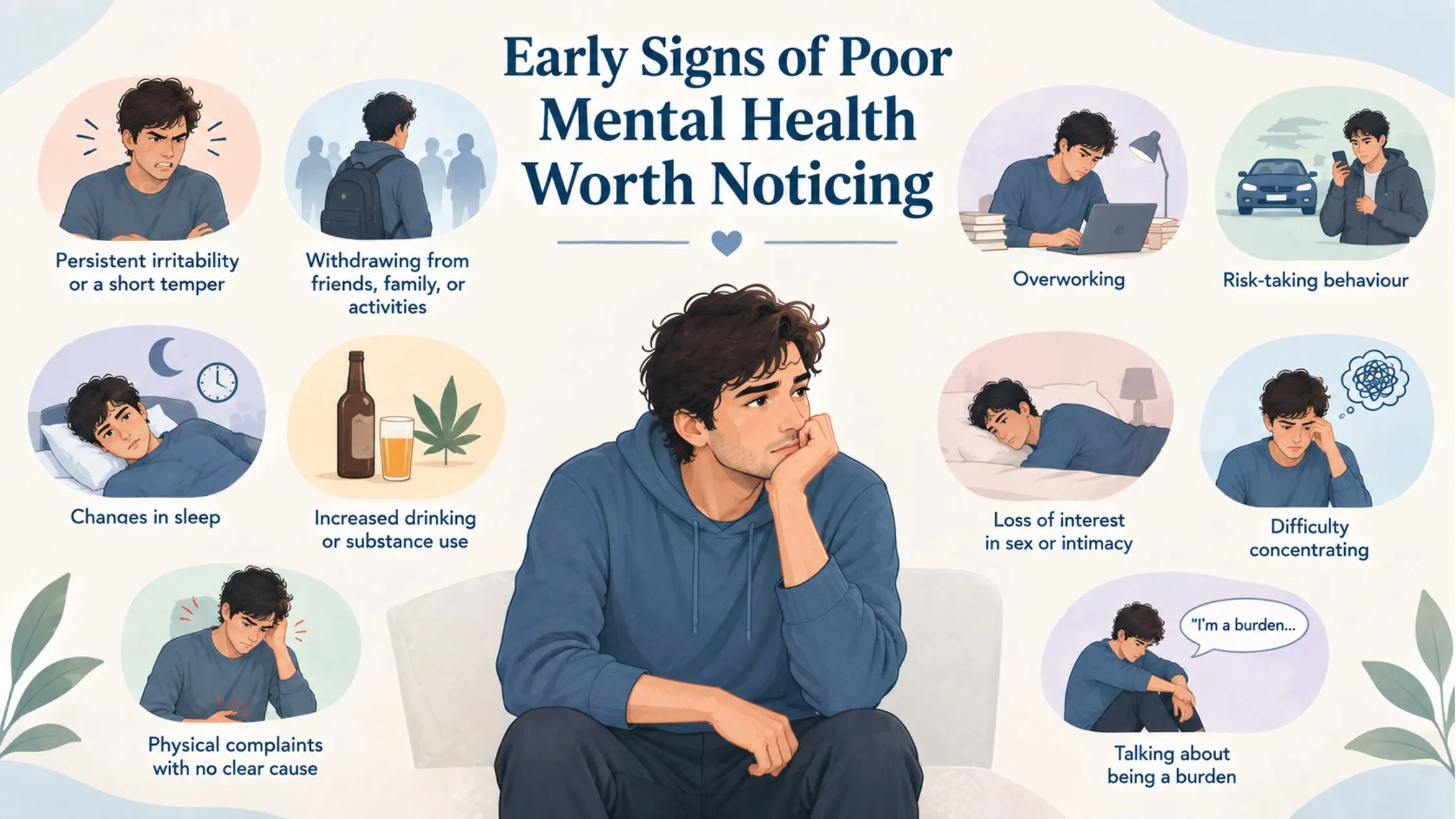
The early signs of poor mental health are usually small and easy to explain away. On their own, any one of these might mean nothing.
Together, or sustained over weeks, they’re worth paying attention to.
- Persistent irritability or a short temper, especially over things that wouldn’t normally bother him.
- Withdrawing from friends, family, or activities he used to enjoy, often with a vague excuse about being busy.
- Changes in sleep, either struggling to fall asleep, waking constantly, or sleeping far more than usual.
- Increased drinking or substance use, used as a way to switch off or get through the evening.
- Physical complaints with no clear cause, such as headaches, muscle tension, or stomach problems.
- Overworking, throwing himself into work or a project as a way of avoiding everything else.
- Risk-taking behaviour, from reckless driving to impulsive spending or gambling.
- Loss of interest in sex or intimacy, often without either partner naming it directly.
- Difficulty concentrating, forgetfulness, or a general sense of being mentally somewhere else.
- Talking about being a burden, or making comments that sound like giving up, even lightly or as a joke.
That last one deserves particular attention. Comments about being a burden, about things being pointless, or about not being around much longer should never be dismissed as a mood or a bad day.
Common Mental Health Warning Signs by Life Stage
Mental health warning signs can shift depending on age and circumstance. Men in their late 40s and early 50s currently carry some of the highest suicide risk in the UK, often linked to relationship breakdown, financial pressure, or job loss at a stage of life when asking for help still feels unfamiliar. Older men, particularly those over 75, face elevated risk too, frequently tied to isolation, bereavement, or physical health decline, and it’s a group that’s easy to overlook because the signs get put down to “just getting older.”
At work, the pressure compounds further. Nearly a million UK workers experienced work-related stress, depression, or anxiety in the last year, a sharp year-on-year rise, with construction workers facing a suicide risk more than three times the national average (Health and Safety Executive, 2025). Financial pressure is now the single biggest external stressor for UK employees, and many still feel unable to raise it with a manager.
Why These Signs of Mental Health Issues Get Missed
Part of the problem is cultural. Many men grow up with an unspoken rule that struggling equals weakness, so distress gets rerouted into anger, work, or silence instead of being named for what it is. Partners, friends, and colleagues often sense something is wrong without being able to put a finger on it, because the signs of mental health issues in men rarely match the picture most people carry in their heads.
The other part is practical. GPs and services are geared toward the presentations they see most often, and a man who turns up irritable and tired rather than visibly low can slip through without the right conversation happening.
Getting Psychological Treatment That Actually Fits
If you recognise several of these signs in yourself or someone close to you, it’s worth taking seriously rather than waiting for things to resolve on their own. Psychological treatment works, and it works particularly well when it’s tailored to how a person actually presents, rather than a generic template.
Dr Kavita Deepak-Knights is a Clinical Psychologist, based in Windsor, Berkshire. With over 20 years of experience, including time within the NHS and a doctorate from Oxford University, she works with men on the issues that often sit behind these warning signs: stress, burnout, anger, low mood, and anxiety that hasn’t been named as such. As a therapist in Windsor, she draws on approaches including CBT, DBT, and EMDR, adapting the treatment to the person rather than expecting the person to fit the treatment. For anyone searching for a psychologist in Windsor who takes this seriously, her practice offers a starting point that doesn’t require having all the words for what’s wrong before booking a first session.
Matters of the Mind is a private psychology practice built around exactly that idea, that men often turn up describing stress, anger, or exhaustion rather than “depression” or “anxiety”, and treatment needs to start from where a person actually is, not from a textbook checklist. The practice offers one-to-one sessions in a private, unhurried setting in Windsor, with the option of in-person or online appointments for anyone who finds a first conversation easier from home. There’s no waiting list bureaucracy to navigate and no need to justify why you’re reaching out. If any of the signs covered here have felt familiar, visiting the Matters of the Mind website is a straightforward way to see how the process works and book an initial session.
Support Starts with Reaching Out
If you’ve noticed changes in your mood, sleep, behaviour, or everyday life, you don’t have to work through them alone. The right support can help you understand what you’re experiencing and find a way forward.
When to Reach Out
You don’t need a diagnosis or a clear explanation to ask for help. If irritability, exhaustion, withdrawal, or any of the signs above have been present for more than a couple of weeks, or if there’s been any talk of being a burden or not wanting to be around, that’s reason enough to speak to a GP or a therapist directly.
If you’re in urgent distress or worried about your safety, contact the Samaritans free on 116 123, available 24 hours a day, or CALM’s helpline on 0800 58 58 58, open from 5pm to midnight daily.
Poor mental health in men is common, and it’s treatable. The hardest part is usually the first conversation. Everything after that tends to get easier.
Frequently Asked Questions (FAQs)
1. What are the most common signs of poor mental health in men?
Irritability, withdrawal from friends and activities, changes in sleep, increased drinking, unexplained physical complaints, overworking, and loss of interest in things he used to enjoy are among the most common. These often show up before, or instead of, obvious low mood.
2. Why don't men show the same mental health symptoms as women?
Men are more likely to externalise distress through anger, risk-taking, or overwork rather than sadness or tearfulness. Cultural expectations around masculinity play a large part in this, alongside a tendency to reroute emotional pain into behaviour rather than express it directly.
3. At what age are men most at risk?
Men in their late 40s and early 50s currently have some of the highest suicide rates in the UK, often tied to relationship breakdown, financial strain, or job loss. Older men, particularly those over 75, are also at elevated risk, frequently linked to isolation and bereavement.
4. When should I be worried about a friend or partner?
If the signs have lasted more than a couple of weeks, are getting worse, or come with any comment about being a burden, feeling hopeless, or not wanting to be around, that’s a clear signal to encourage them to speak to a GP or therapist, or to contact a crisis line directly.
5. What kind of treatment actually helps?
Approaches like CBT, DBT, and EMDR are all evidence-based options, and the right one depends on what’s driving the distress. Therapy tends to work best when it’s tailored to how a person actually presents rather than following a fixed script, which is particularly important for men whose symptoms don’t always fit the textbook picture.
6. Where can I get immediate support if I'm worried about my safety?
Contact the Samaritans free on 116 123, available 24 hours a day, or CALM’s helpline on 0800 58 58 58, open from 5pm to midnight daily. Both offer confidential support with no need to explain yourself in advance.


