
Negative thinking can feel relentless. It can show up as self-doubt, worry, fear of failure, or a constant habit of expecting the worst. Over time, these patterns can affect mood, relationships, confidence, and the ability to respond calmly to everyday challenges.
This is where cognitive behavioural therapy can be helpful. This approach focuses on the connection between thoughts, emotions and behaviours. Instead of trying to force thoughts away, CBT helps you to understand them, question them and respond in healthier ways.
For individuals struggling with negative thoughts, CBT is one of the most practical and empowering therapeutic approaches. Whether the concern is overthinking, anxiety or self-recurring patterns, this approach offers a structured help that can bring a meaningful change.
Let’s talk in this blog about the seven powerful CBT techniques that can break the cycle of negative thinking.
Effective CBT Techniques To Break Negative Thinking Patterns
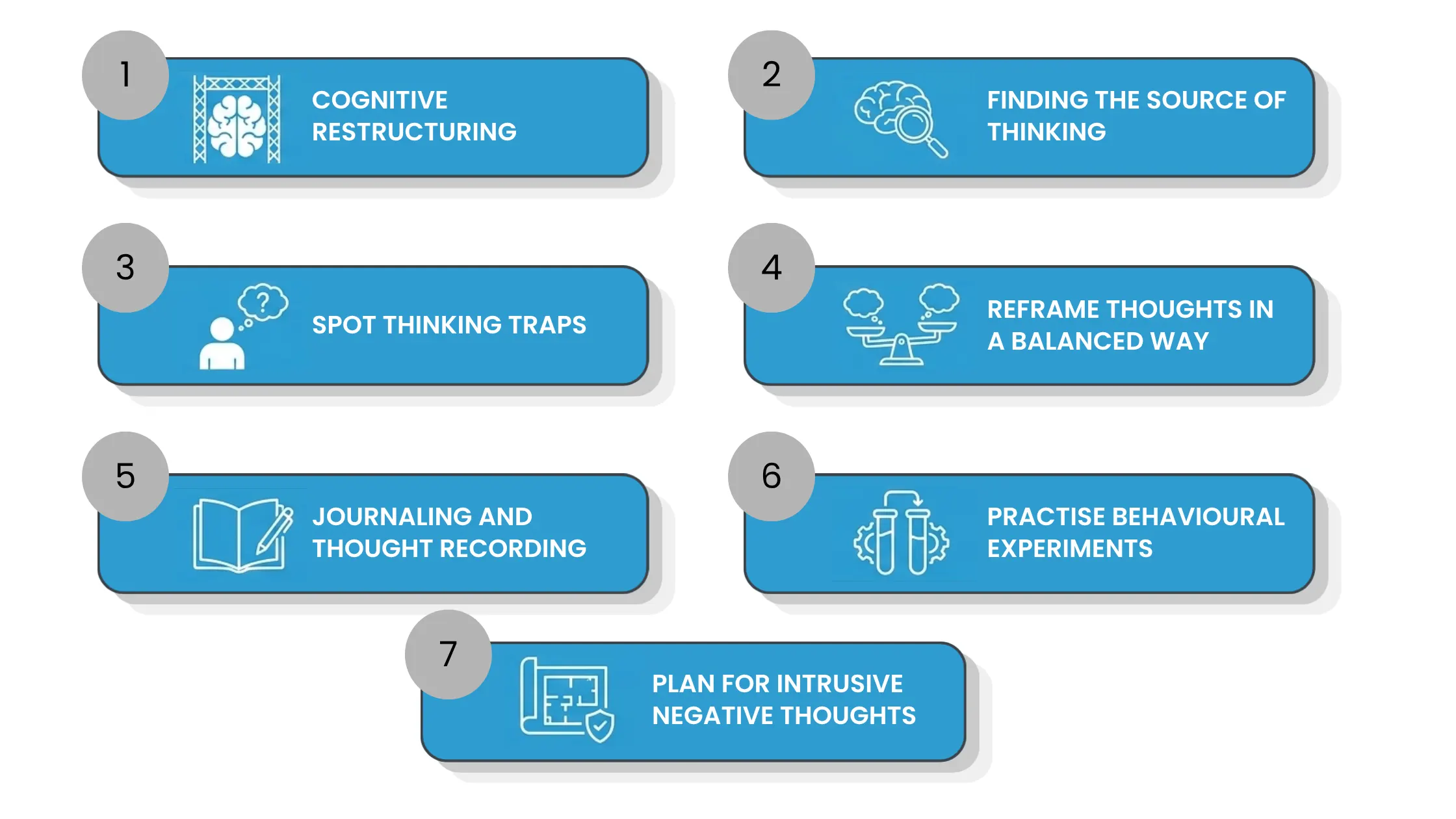
1. Cognitive restructuring
Cognitive restructuring is one of the most well-known CBT techniques. Many people try to change their thinking before they have clearly identified what they are thinking. But CBT involves identifying the negative thought patterns that drive your emotional reaction and replacing them with balanced alternatives.
Try asking yourself:
What was going through my mind just now?
What exactly am I telling myself?
What triggered this thought?
When you begin to name your thoughts, you begin to take away some of its power.
2. Try to find the source of thinking
One of the most useful CBT techniques is learning to separate feelings from facts. When emotions are strong, thoughts can feel completely true, even when they are not fully accurate.
In this stage, gently ask:
What evidence supports this thought?
What evidence do I have against it?
Am I assuming the worst?
This technique is especially helpful for people dealing with overthinking and anxiety, because anxious minds often focus on threat and ignore balance.
3. Spot thinking traps
Negative thinking often becomes stronger when it follows predictable mental habits. CBT calls these patterns cognitive distortions. They are not signs of weakness; they’re common thinking traps that many people fall into.
Some examples include:
All or nothing thinking: If I am not perfect, I have failed.
Catastrophising: This small issue will ruin everything.
Mind reading: They did not reply, so they must be upset with me.
Personalisation: It must be my fault
Once you begin to recognise these patterns, it becomes easier to step back from there. You are no longer treating every thought as a fact. You are observing a pattern. This awareness is a core part of CBT for negative thoughts.
4. Reframe the thought in a more balanced way
Reframing does not mean pretending everything is fine. It means replacing an extreme or distorted thought with one that is more realistic and helpful. For instance, “I always fail” can become “I made a mistake, but that does not define me.” “I cannot handle this” can become “This feels difficult, but I can take it one step at a time.”
A balanced thought is not overrealistic. It is simply fair. This technique works well because the mind often believes repeated messages. When you consistently practise more balanced self-talk, your inner narrative begins to shift.
5. Journaling and thought recording
The best thing you can do is to track your negative thoughts even when you are not actively challenging them. Write them down in a journal, and over time, identify recurring themes and patterns. Find the beliefs that underlie them so that you can analyse them with better clarity. Writing helps your cluttered thoughts to settle down and find a better approach to the negative thoughts.
6. Practise behavioural experiments
Sometimes the mind tells us something very strongly, but real-life experience tells a different story. That is where behavioural experiments can help. A behavioural experiment involves testing a thought in real life instead of accepting it automatically.
If you think I speak up, people will judge me, “ you might try sharing a small opinion in the meeting.”
These experiments are not proving you wrong. They are about gathering real evidence. Over time, this helps reduce fear and build confidence.
7. Create a plan for intrusive negative thoughts
Some thoughts feel unwanted, repetitive and difficult to switch off. These may be intrusive negative thoughts. They can appear suddenly and create distress, even when the person does not believe them deeply.
The goal is not to fight them aggressively. In many cases, fighting the thought can make it stronger. Instead, CBT encourages a calmer, more structured response.
Try this once
Label the thought: This is an intrusive thought
Avoid arguing with it endlessly
Return attention to the present moment
Use grounding techniques such as noticing five things you can see and focusing on your breathing.
This can be especially helpful when intrusive negative thoughts are connected to stress, fear, or overthinking and anxiety. The aim is to reduce the power of the thought, not to force it away.
Take the First Step Towards Emotional Clarity Today
Negative thoughts can affect confidence, emotional well-being, relationships, and everyday life. With the right support and practical coping strategies, it is possible to develop healthier thinking patterns and a more balanced mindset.
A Gentle Reminder
Not every negative thought needs to be fixed immediately. Sometimes the more helpful step is simply to notice it, breathe through it, and respond with a little more compassion.
If negative thinking is affecting your sleep, focus, relationships, or daily functioning, it may help to seek professional support. With the right guidance, cognitive behavioural therapy can offer a safe and effective path toward greater clarity and emotional balance.
Final Thoughts
Breaking the cycle of negative thinking is not about becoming positive all the time. It is about becoming more aware, more balanced, and more grounded in reality.
These seven CBT techniques can help you:
-
- recognise unhelpful thought patterns,
- challenge distorted assumptions,
- respond to distress with more balance,
- build a calmer relationship with your mind.
With steady practice, CBT for negative thoughts can become a powerful support for emotional well-being, especially when dealing with overthinking and anxiety or repeated intrusive negative thoughts. A more balanced mind is often built one small thought at a time.
If persistent negative thoughts are beginning to affect your emotional well-being, daily routine, relationships, or sense of self, seeking professional support can make a meaningful difference.
Dr Kavita Deepak-Knights offers compassionate and personalised therapeutic support to help individuals better understand their thoughts, manage emotional challenges, and build healthier coping patterns through approaches such as cognitive behavioural therapy. Taking the first step towards support can often be the beginning of lasting emotional clarity and resilience.
Frequently Asked Questions (FAQs)
1. Can negative thinking affect mental well-being?
Yes, persistent negative thinking can affect emotional well-being, confidence, sleep, relationships, and daily functioning. It may also contribute to stress, anxiety, and low mood if left unaddressed.
2. How can I stop constantly thinking negatively?
Learning to recognise thought patterns, practising self-awareness, challenging unrealistic assumptions, and developing healthier coping strategies can help reduce negative thinking over time.
3. Are intrusive negative thoughts normal?
Many people experience intrusive negative thoughts from time to time, especially during periods of stress or anxiety. While they can feel upsetting, they do not define who you are.
4. Can journaling help with negative thoughts?
Yes, journaling can help organise thoughts, identify emotional triggers, and improve self-awareness. Writing thoughts down often makes them feel less overwhelming and easier to understand.
5. Can therapy help break the cycle of negative thinking?
Yes, professional psychological therapy can help individuals better understand their thought patterns, manage emotional distress, and develop healthier ways of coping with challenges.


