
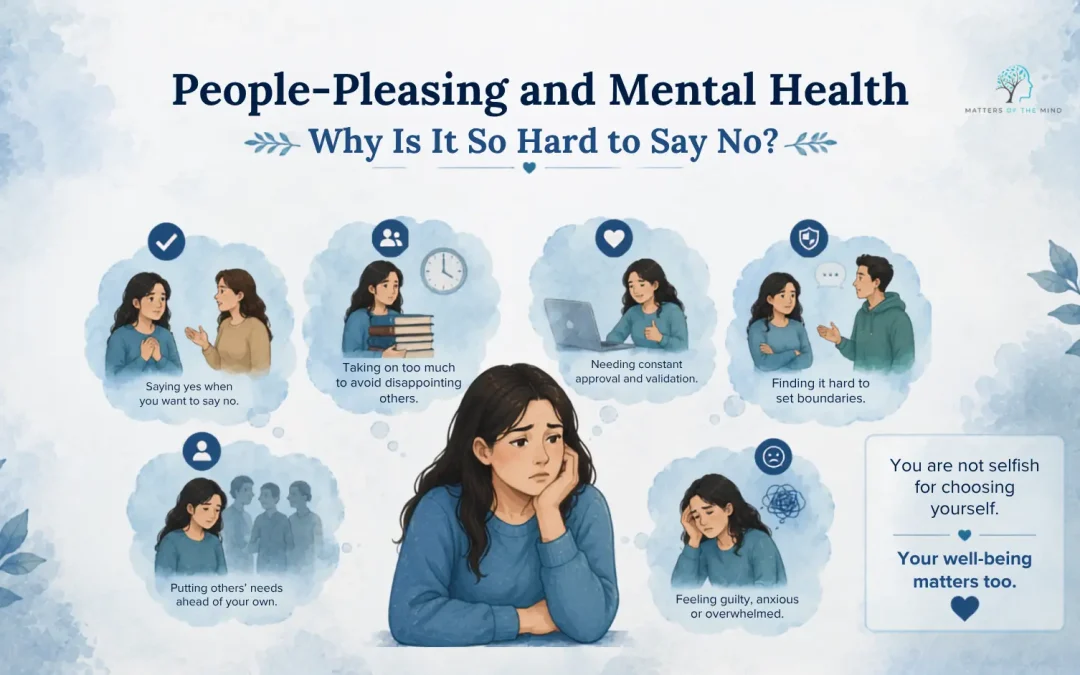
There’s a specific kind of tiredness that comes from typing “sure, no worries!” when it very much is a worry. Maybe you’ve covered a shift you couldn’t spare, or told a friend a haircut looked great when it didn’t, or heard yourself say “honestly, it’s fine” through gritted teeth. Fine enough on its own, most of us do it sometimes. But for some people yes stops being a choice. It’s just what comes out, automatically, and the no that should’ve come out instead sits in the stomach for the rest of the day, uninvited.

There’s a name for it. People-pleasing. Won’t find it in a diagnostic manual as its own thing, but ask any therapist and they’ll tell you it comes up all the time, usually tangled into anxiety, low self-worth, or a family history nobody’s ever really unpacked. If you’ve lived inside it, you know the exhaustion is oddly specific. Hard to explain to someone who’s never had to think twice before ordering their own coffee.

What Is People-Pleasing, Really?

Putting other people’s comfort ahead of your own, again and again, even when it costs you something real – that’s roughly the shape of it. People mix this up with kindness constantly, and it isn’t the same thing at all. A genuinely kind person can say no and still mean well by it. A people-pleaser says yes, and then spends the evening quietly furious at themselves.

Mostly it lives on the inside. Someone can seem completely easygoing while privately keeping score of every favour, feeling unseen, dreading the next ask before it’s even arrived. The niceness is doing a job. It’s not really who they are, even if it’s been running so long it’s started to feel that way.

The Psychology Behind People-Pleasing: Why Saying No Feels So Hard
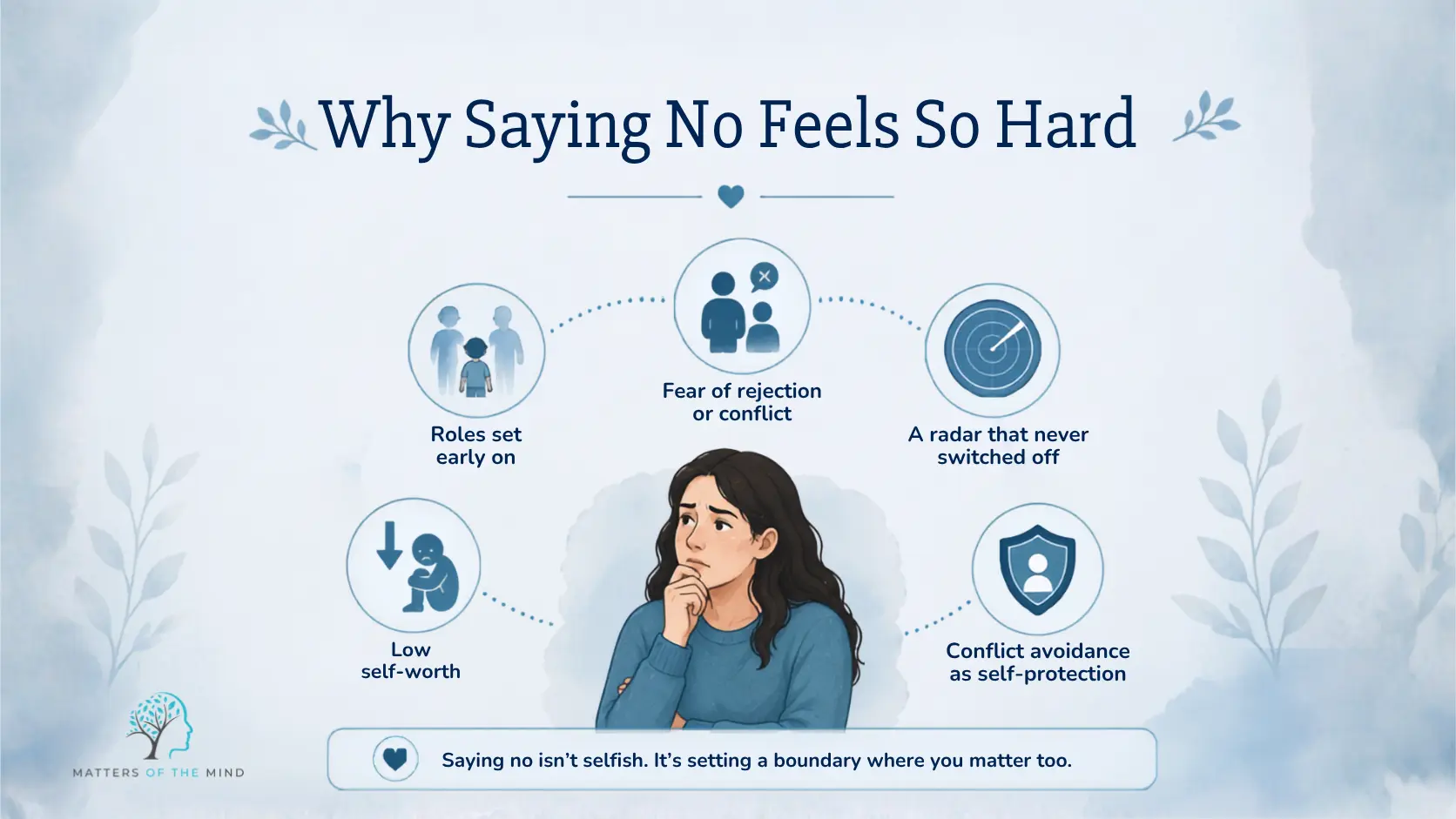
Here’s what tends to get missed. This isn’t a character flaw, and it’s got nothing to do with backbone. Mostly it’s a strategy that got learned early, back when it actually worked, and nobody ever sent the memo saying it could retire.
Minimalist infographic explaining five reasons why saying no can feel difficult: fear of rejection or conflict, roles set early on, low self-worth, constant alertness, and conflict avoidance as self-protection.

Fear of rejection or conflict

Disagreement, for a lot of people-pleasers, was never a normal, survivable part of a relationship growing up. It was a risk. At some point saying no got wired straight to losing someone’s approval, maybe their affection outright, so the brain built itself a shortcut around it: agree now, work out how you actually feel about it later, assuming there’s time left over for that.

Roles set early on

Picture a kid growing up somewhere love felt conditional. A parent who was unpredictable, or harsh, or just too stretched to notice what the kid actually needed. That kid works out fast, usually faster than anyone realises, that being easy and helpful is the safest way to stay close to the people they depend on. Eventually the kid grows up. Doesn’t mean the habit clocks off with them – plenty of forty-year-olds are still running the exact same programme.

Low self-worth

When your sense of value is mostly tied to being useful, a no isn’t just about one evening or one favour anymore. It goes after the whole scaffolding self-esteem is balanced on. Helping stops generosity somewhere along the way and turns into proof, delivered on repeat, that you’re worth keeping around.

A radar that never switched off

A lot of people-pleasers read a room unusually well, and that skill got built for a reason. Somewhere, once, moods turned fast and it paid to catch it coming. The trouble now is the radar never got the update. It keeps scanning long after the room, and the people sitting in it, have actually changed

Conflict avoidance as self-protection

Saying no risks an argument, a sulk, a conversation that drags on far past where it needed to end. If nobody ever showed you that conflict is survivable, let alone something that can actually get resolved, avoiding it altogether looks like the only option that makes sense. The relief is instant. What follows – usually resentment, quietly compounding somewhere out of sight – tends to surface weeks later, attached to something that has nothing to do with the original task.

None of it makes a people-pleaser fragile. It means the behaviour’s been doing a job this whole time, and figuring out what that job actually was matters a great deal more than being told, again, to just grow a spine.

Signs You Might Be a People-Pleaser

A few worth checking yourself against:

    • You apologise for things that clearly aren’t your fault. Someone else walks into you, and somehow you’re the one saying sorry.
    • You agree before you’ve actually thought about it. The real answer shows up afterwards, usually right after it’s too late to take it back.
    • “Whatever you want” is basically a reflex. So much of one that you’ve genuinely lost track of what you’d pick if someone made you answer honestly.
    • Other people’s moods feel like your responsibility. Someone’s disappointment or irritation, and suddenly it’s a problem you’re personally on the hook to fix.
    • You go quiet exactly when something’s bothering you. Speaking up feels like more risk than it’s worth, even about things that actually matter to you.
    • Resting comes with guilt attached. As if your worth needs earning through output rather than just existing.

None of that is a character indictment if a few of these land. It usually just means a strategy that once kept you safe has been doing more driving lately than you’d like.

How to Stop Being a People-Pleaser

Nobody unlearns this overnight by going cold, and honestly, trying to force that usually backfires anyway. It’s slower work than that. More like loosening a grip finger by finger.

Get used to disappointing people, in small doses

Someone being briefly annoyed with you is not the same thing as being abandoned by them – even though, in the moment, those two things can feel identical. Sitting with that discomfort instead of rushing to fix it is most of the actual work here.

Buy yourself time before answering

“Let me check and come back to you.” Full sentence. Genuinely useful one too, because it interrupts the reflex to say yes before you’ve even asked yourself what you actually want.

Practise on the small stuff first

Nobody needs to open with telling their boss no. Start with the restaurant you don’t fancy, or the plan you’d honestly rather skip. Get the muscle moving somewhere low-stakes before it gets tested where it actually counts.

Notice the story running underneath

Usually it sounds something like “if I say no, they’ll think I don’t care” or “if I disappoint them, that’s it, they’re gone.” Naming that story out loud doesn’t switch it off immediately. It does put a little space between you and the automatic yes, though, and that space is where the actual choosing happens.

Work out what you actually want

Years spent tracking everyone else’s preference will genuinely blur your own – it’s not an exaggeration. So ask the small, ordinary questions on purpose: what do I want for dinner, how do I actually feel about this plan, would I still pick this if nobody else’s opinion were sitting in the room with me.

Consider talking to a therapist

Where this traces back to childhood, or trauma, or anxiety that’s been quietly steering things for years, a therapist tends to get you further than willpower alone ever will. CBT can help unpick the anxious thinking driving the day-to-day behaviour. Trauma-informed or relational therapy is usually better placed for tracing back to where the pattern actually started.

Take the First Step

If social anxiety is affecting your confidence or daily life, professional support can help you build practical coping strategies and feel more at ease in social situations.

Where this traces back to childhood, or trauma, or anxiety that’s been quietly steering things for years, a therapist tends to get you further than willpower alone ever will. CBT can help unpick the anxious thinking driving the day-to-day behaviour. Trauma-informed or relational therapy is usually better placed for tracing back to where the pattern actually started.
People-pleasing gets called kind. Underneath, more often than not, it’s fear wearing something more socially acceptable. It develops for reasons that make total sense at the time – staying safe, staying loved – and unpicking it is slow, patient work rather than one clean breakthrough moment. Saying no properly isn’t about becoming harder to reach. It’s about finally putting yourself on the list of people whose needs get to count. If this is shaping your relationships, your work, or how you see yourself day to day, it’s worth raising with a therapist or counsellor. You genuinely don’t have to work through this alone.
If any of this has stirred something difficult and you’re going through it yourself right now, please don’t carry it alone. Speak to your GP, call the Samaritans free on 116 123, or text SHOUT to 85258 – support’s there any time, day or night.

Frequently Asked Questions (FAQs)

1. Is people-pleasing an actual mental health condition?

Not on its own, no. It’s a behavioural pattern rather than a diagnosis, though it very often turns up alongside anxiety, low self-esteem, or unresolved trauma – and it can weigh on you just as heavily as something with a formal label would.

2. Why do I feel so guilty saying no, even over tiny things?

Usually that guilt was learned, often a long time back, somewhere saying no actually was risky or brought on disapproval that wasn’t easy to shake off afterwards. The feeling itself is real. It just isn’t a reliable signal that you’ve done anything wrong in the present.

3. Does this always trace back to childhood?

Not always – but often enough that it’s worth asking yourself the question honestly. Someone who grew up managing a parent’s mood, or dodging conflict, or earning love through being useful, tends to carry that pattern well into adulthood, long after whatever made it necessary in the first place is gone.

Dr. Kavita Deepak-Knights
About the Author

Dr Kavita Deepak-Knights linkdin icon

With over 20 years of clinical experience, Dr Kavita brings a trusted and expert approach to mental health care. As the founder of Matters of the Mind and an Oxford-trained psychologist, she specialises in evidence-based therapies, including CBT, ACT, DBT, and EMDR, offering personalised support to help individuals understand their challenges and enhance their overall well-being.