
You wake up already tense. By lunchtime your shoulders are up around your ears. In the evening you’re too wired to relax and too tired to do anything useful. Then tomorrow it starts again. If that’s been your life for weeks, or months, it might not be a rough patch. It could be chronic stress.
Most of us know the short, sharp kind of stress. A deadline. An awkward conversation. It spikes, then it passes. Chronic stress doesn’t pass, and that’s the whole problem.
Chronic stress definition: chronic stress is stress that carries on for weeks or months with no real break, so your body stays on alert and never gets the chance to settle.
What Chronic Stress Actually Means
Let’s start with the basics. Stress is your body’s reaction to pressure. The NHS explains that when you feel anxious or scared, your body releases stress hormones such as adrenaline and cortisol. That’s useful in the short term. It can help you get things done. You might notice a faster heartbeat or a bit of sweating, then it fades.
The meaning of chronic stress comes down to one word: duration. The pressure keeps coming, so the hormones keep flowing, and your body never gets the signal that it’s safe to stand down. It doesn’t have to be one huge event either. A small, constant pressure can wear you down just as much as a single big one. Think of a leaking tap versus a burst pipe. The tap is less dramatic, but leave it long enough and the damage is the same.
How Common Is It?
More common than most people think. A Mental Health Foundation survey of 4,619 UK adults, carried out by YouGov in 2018, found that 74% had felt so stressed at some point in the past year that they were overwhelmed or unable to cope. That survey asked about overwhelming stress, not chronic stress specifically, and it’s a few years old now. But it shows how close to the edge a lot of people are.
Work is a big part of it. The Health and Safety Executive’s latest figures for Great Britain estimate that 964,000 workers had work-related stress, depression or anxiety in 2024/25. That led to around 22.1 million working days lost. Note that the HSE groups stress, depression and anxiety together, so not every one of those cases is stress on its own.
Signs of Chronic Stress
The signs of chronic stress are easy to miss, because they build slowly. You adjust. You get used to feeling rubbish and call it normal. The NHS groups the symptoms of stress into three areas, and it helps to check yourself against each one.
In your body
- Headaches or dizziness
- Muscle tension or aches that never quite go away
- Stomach trouble
- A racing heart or chest pain
- Getting ill more often, or struggling to shake colds
In your head
- Trouble concentrating
- Finding it hard to make even small decisions
- Constant worry
- Forgetting things you’d normally remember
- A sense that everything is too much
In how you behave
- Snapping at people over nothing
- Pulling away from friends
- Sleeping badly, or sleeping far too much
- Drinking, smoking or eating more to take the edge off
One or two of these now and then is normal. A cluster that sticks around for weeks is a different story.
What Causes Chronic Stress?
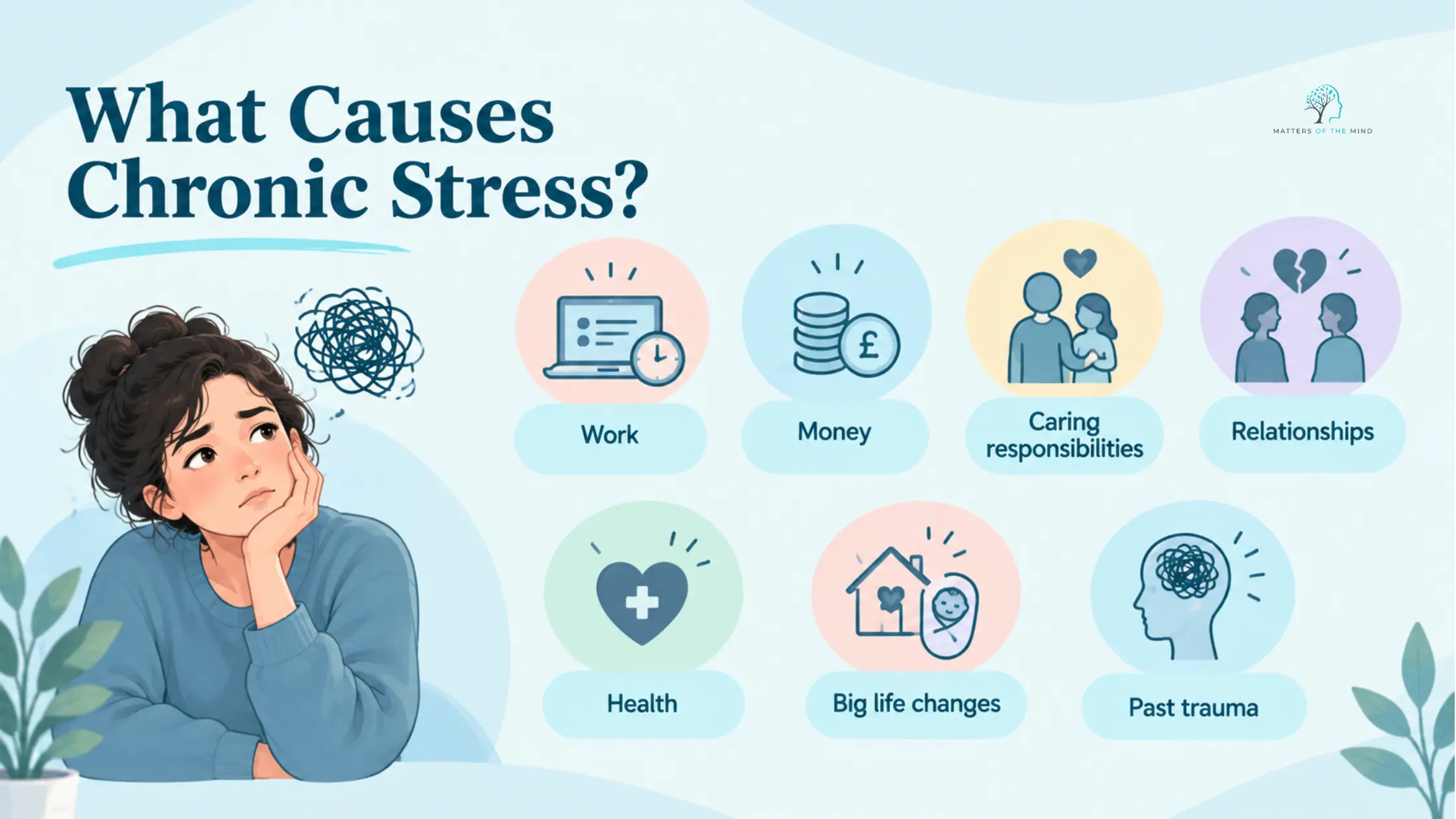
There’s rarely a single cause. Usually it’s a pile-up. These are the common ones:
- Work. Heavy workloads, long hours, job insecurity, a difficult manager, or never being able to switch off.
- Money. Debt, rising bills, or simply never feeling secure.
- Caring responsibilities. Looking after children, a partner or a parent, often with little help or rest.
- Relationships. Ongoing conflict, an unhappy home, or loneliness.
- Health. Living with a long-term illness, pain or a condition that’s hard to manage.
- Big life changes. The NHS points out that even good events, like buying a house or having a baby, can pile on stress.
- Past trauma. If your system learned early on that the world isn’t safe, it can stay braced for danger long after the danger has gone.
Personality plays a part too. Perfectionists, people-pleasers and anyone who finds it hard to say no tend to take on more than they can carry, and they keep carrying it.
The Effects of Chronic Stress
This is where chronic stress gets serious. Your body wasn’t built to run on high alert for months. The Mental Health Foundation says stress is a significant factor in mental health problems such as anxiety and depression. It also links stress to physical problems, including heart disease, a weaker immune system, insomnia and digestive trouble.
The NHS adds that long-term stress can leave you physically, mentally and emotionally exhausted, which is often called burnout. If you’ve ever felt flat, numb and unable to care about things you used to enjoy, that may be what it feels like from the inside.
The effects spill into everyday life too. Your sleep suffers, so you’re more irritable. You’re irritable, so your relationships take a hit. Your concentration slips, so work gets harder. Each problem feeds the next, which is why chronic stress can feel like it’s taking over everything.
Ways to Cope With Chronic Stress
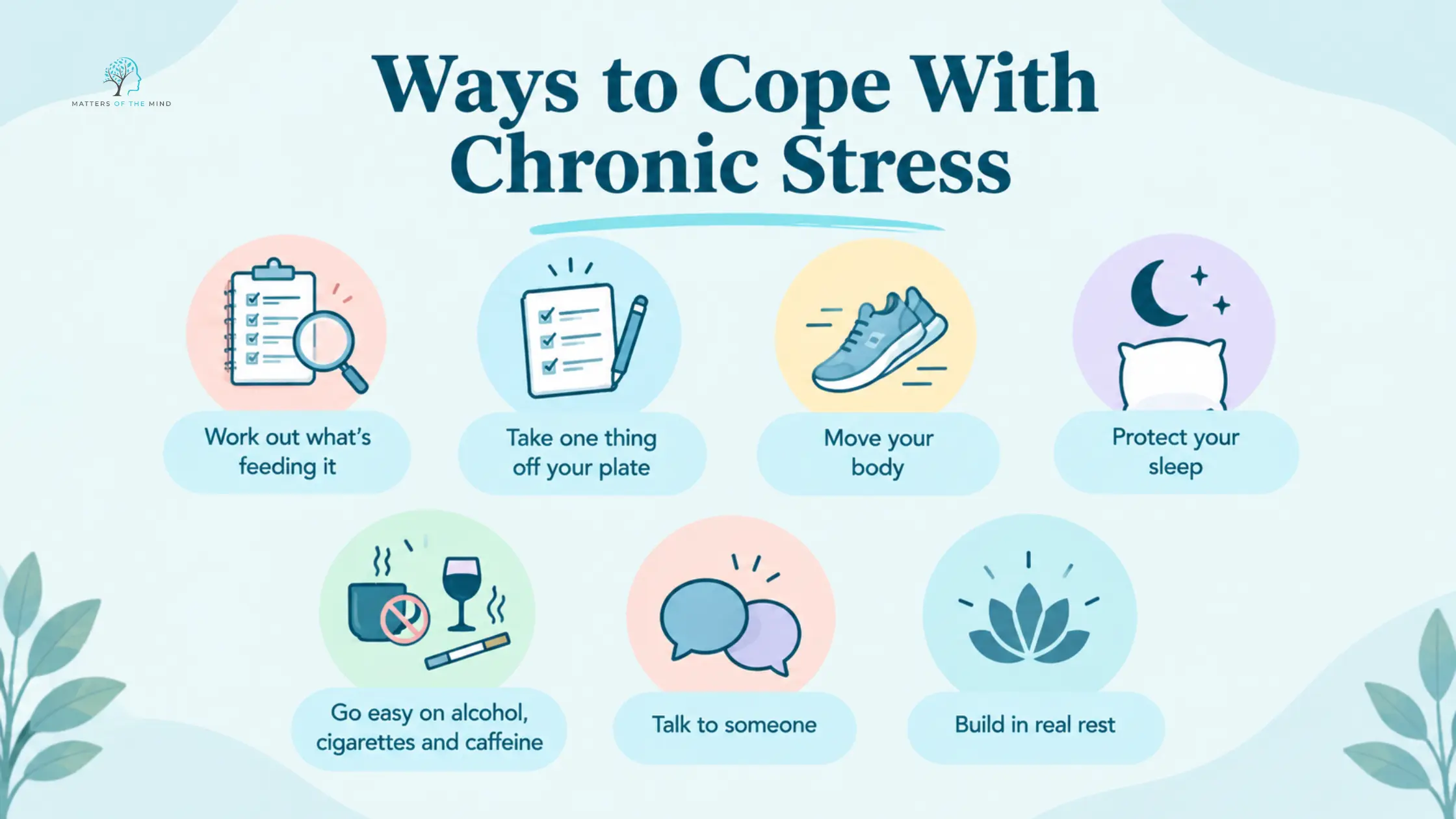
You won’t remove all stress, and you don’t need to. The aim is to give your body regular chances to come back down.
Here’s where to start.
Work out what’s feeding it
Write it all down, even if it looks messy. Then sort it into two lists: things you can change and things you can’t. Put your energy into the first list. It’s a small step, but it stops the vague, heavy feeling that everything is wrong at once.
Take one thing off your plate
Not everything. Just one. Say no to one request, hand over one task, or drop one thing that doesn’t matter much. Small cuts add up.
Move your body
The NHS says exercise can help with managing stress. It doesn’t have to be a gym session. A brisk twenty-minute walk counts.
Protect your sleep
Poor sleep and stress feed each other, so this one matters. Keep regular bedtimes, keep screens out of the last hour, and write down tomorrow’s worries before you get into bed.
Work out what’s feeding it
Write it all down, even if it looks messy. Then sort it into two lists: things you can change and things you can’t. Put your energy into the first list. It’s a small step, but it stops the vague, heavy feeling that everything is wrong at once.
Go easy on alcohol, cigarettes and caffeine
They feel like they help. The NHS warns that using alcohol, cigarettes, gambling or drugs to cope can contribute to poor mental health, so they tend to make things worse in the long run.
Talk to someone
A friend, a partner, a colleague, anyone you trust. Saying it out loud often takes some of the weight off.
Build in real rest
Scrolling your phone isn’t rest. Real rest is something that lets your body slow down, like a walk, a bath, music, or sitting in the garden for ten minutes with nothing in your hands.
Start Feeling Like Yourself Again
Take the first step today!
Book a confidential session with Dr Kavita Deepak-Knights in Windsor, Berkshire, and begin restoring your emotional balance.
When to Get Help
If you’ve tried the basics and you’re still struggling, it’s time to get support. That isn’t a failure. It means the load is bigger than self-help can fix on its own.
The NHS advises speaking to a GP or calling 111 if you’re struggling to cope with stress. If you live in England, you can refer yourself to NHS Talking Therapies without seeing a GP first, and treatments such as CBT can help you change the thought patterns that keep stress going. A private therapist or clinical psychologist is another option if you’d like to start sooner or want a more personal approach.
If you’d like to speak to someone privately, you can reach out to Dr Kavita Deepak-Knights, a clinical psychologist based in Windsor, Berkshire, and founder of Matters of the Mind. She works with adults dealing with stress, anxiety and burnout, using evidence-based therapies like CBT to get at the thinking and habits that keep stress going. You don’t have to wait until things fall apart to ask for help. Earlier is usually easier.
Frequently Asked Questions (FAQs)
1. What's the difference between stress and chronic stress?
Normal stress is a short reaction to a specific pressure, and it fades once the pressure is gone. Chronic stress carries on for weeks or months, so your body stays on alert and has no time to recover.
2. How long does stress have to last to be chronic?
There’s no single cut-off that every professional uses. As a rough guide, if the stress has lasted weeks or months and isn’t easing, treat it as chronic and think about getting support.
3. Can chronic stress make you physically ill?
It can contribute to physical problems. The Mental Health Foundation links stress to heart disease, a weaker immune system, insomnia and digestive trouble. If you’re worried about any symptom, see your GP.
4. Can chronic stress go away on its own?
Sometimes, if whatever caused it ends and you get proper time to recover. Often it doesn’t, because the cause is ongoing. That’s why changing the situation, or getting help to cope with it, usually matters more than waiting it out.


