
Cast your mind back to one of the harder periods of your life. Could be recent, could be years ago. Now ask yourself — what actually got you through it?
For most people, when they’re honest, the answer involves someone else. A friend who showed up. A person who kept checking in even when you told them you were fine. Someone who just knew, without being told, that you needed company more than advice.
We don’t give friendships nearly enough credit when we talk about mental health. We talk about therapy, medication, mindfulness, exercise — and all of those things genuinely help. But friendship sits alongside all of it, doing quiet, steady work that we rarely stop to acknowledge. For some people it’s the thing that’s been holding them together for years without either of them realising it.
So in this blog, let’s look at what good friendships actually do for mental wellbeing, why they’re harder to maintain than anyone admits, and what happens when the loneliness starts to creep in.
30th July Is International Day of Friendship — And It’s More Than Just a Date
Every year on 30th July, the United Nations marks the International Day of Friendship. It was officially proclaimed by the UN General Assembly in 2011, built on the idea that friendship between people, countries and cultures can inspire peace and build bridges where division might otherwise take hold. Which sounds grand. But strip it back and the message is actually quite ordinary, in the best possible way, that the connections we form with other people matter. Genuinely matter.
We tend to think of awareness days as something that happens on social media and then gets forgotten by teatime. This one is worth pausing on for a moment, though. Because if you look at the mental health data, and we will, in a moment, the case for taking friendship seriously is overwhelming. Not as a soft, feel-good concept, but as something with measurable, significant effects on how healthy and happy people actually are.
What Does Friendship Have to Do With Mental Health?
More than you’d think, and the evidence is pretty striking.
Harvard University has been running what’s called the Study of Adult Development since 1938. Nearly nine decades. They followed hundreds of people across their entire adult lives — their health, their relationships, their income, their happiness — and they kept following their children too. It’s one of the most comprehensive long-term studies ever done on what makes a good human life.
And what came out of it? Not wealth. Not status. Not physical health habits, though those matter too. The clearest predictor of who stayed healthy and happy into old age was the quality of their close relationships. People who were most satisfied in their friendships at 50 were, on average, the healthiest at 80. Full stop.
Dr Robert Waldinger, who leads the study now, has talked about this finding a lot. His summary is almost annoyingly simple: good relationships keep us happier and healthier. That’s it. Eighty-plus years of research, and it comes down to that.
Biology is interesting too. When you spend time with someone you actually trust — not just acquaintances, but people who know you properly — your brain releases oxytocin and your cortisol levels drop. Your body physically relaxes in a way it doesn’t in isolation. There’s a reason we instinctively call people when something’s gone wrong. We’re not just looking for advice. We’re regulating.
A large review published in PLOS Medicine, which pulled together 148 different studies and looked at data from more than 308,000 people, found that those with strong social connections were 50% more likely to survive to old age than those who were poorly connected. That figure sits in the same range as giving up smoking. And yet nobody talks about friendship as a public health issue? Not really.
Why Do We Struggle to Maintain Friendships as Adults?
Here’s the thing nobody really prepares you for. Friendship gets harder. Not because people get worse at it — just because the structure that used to hold it all together disappears.
When you’re at school or university, proximity does most of the work. You’re around the same people constantly. Friendships form without much effort because they don’t need much effort — you’re just there, together, repeatedly. Then adulthood arrives and the scaffolding is gone. Suddenly maintaining relationships requires actual initiative, which is a lot to ask of people who are also managing careers, money worries, relationships, families, health concerns and the general low-level exhaustion of modern life.
So friendships slip. Slowly, usually. Nobody decides to let them go. You just keep meaning to reply and then not quite getting round to it, until months have passed and it starts to feel awkward to reach out.
The loneliness numbers in the UK reflect this more than most people realise. The NHS England Health Survey for England 2024 found that 29% of adults aged 16 to 24 report feeling lonely at least some of the time — making them, rather surprisingly, the loneliest age group in the country. Not older adults. Young people. The British Association for Counselling and Psychotherapy found that 72% of people aged 16 to 25 say loneliness has a direct negative effect on their mental health.
Those aren’t small numbers.
For people in middle age and beyond, the pattern is different but the risk doesn’t go away. Networks shrink. Old friends move, or get absorbed into their own family lives. And the longer someone goes without meaningful connection, the more the gap starts to feel unbridgeable — even when it isn’t.
How Good Friendships Support Your Mental Wellbeing
Friendship does several distinct things for mental health, and it’s worth being specific because they’re not all obvious.
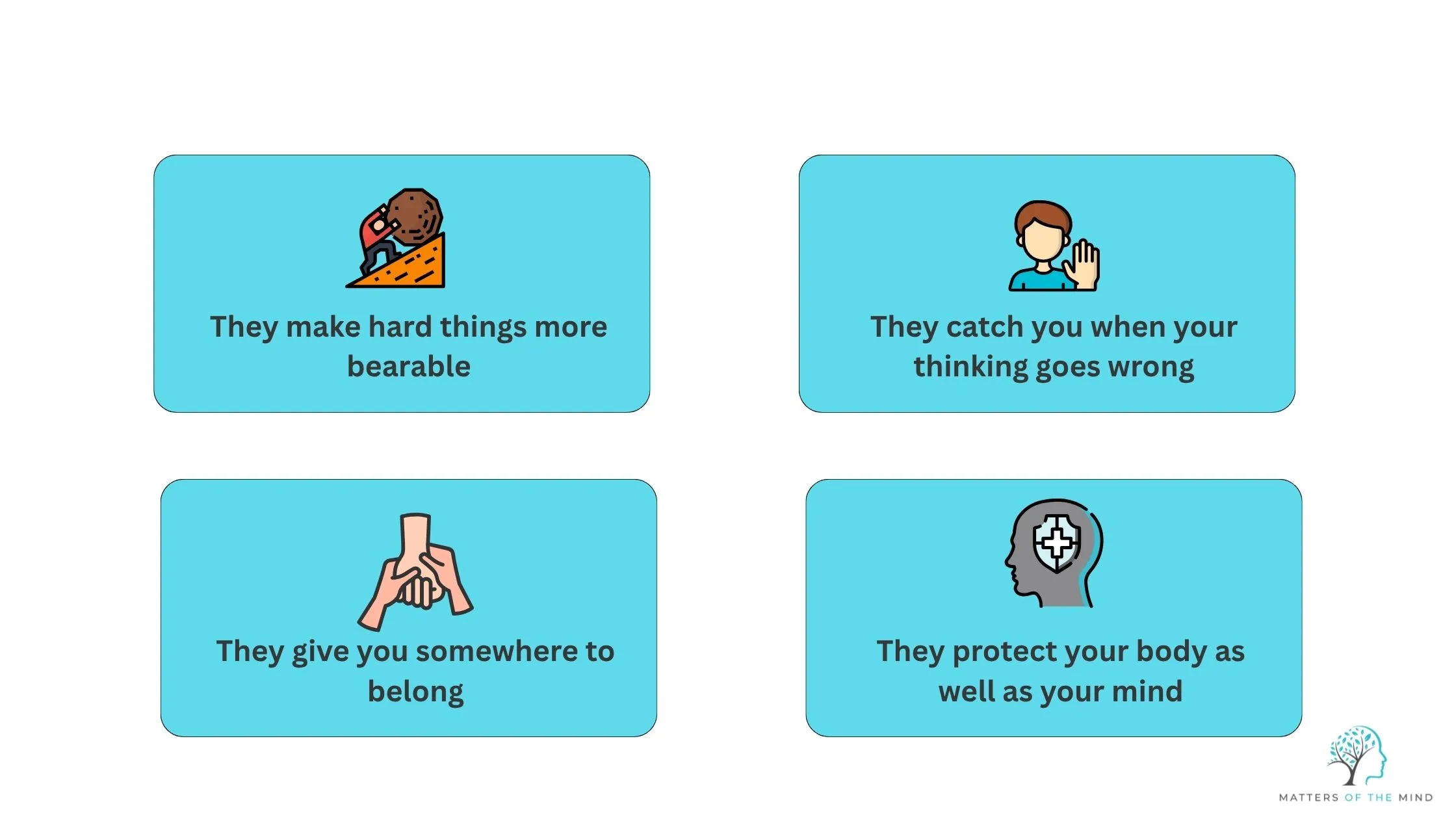
1. They make hard things more bearable
There’s a particular kind of relief that comes from telling someone what’s really going on and having them not try to fix it. No silver linings, no reframes, no “have you tried just—”. Just someone who hears it and stays. That experience — being witnessed without being managed — is harder to find than it sounds, and it does something genuinely important. It makes difficult things feel survivable rather than overwhelming.
The ONS found that 55% of adults with moderate to severe depressive symptoms report feeling lonely often or always. Nearly three times the rate of people without significant symptoms. That’s not a coincidence. Isolation and low mood reinforce each other, reliably, in both directions. Breaking the isolation — even a little — tends to shift things. Not always dramatically. But it shifts.
2. They catch you when your thinking goes wrong
Depression and anxiety are remarkably good at distorting the way you see yourself. You start believing things that aren’t really true — that you’re a burden, that you’ve always been like this, that nothing’s going to change. And because you’re living inside your own head, those thoughts can feel like facts.
A good friend tends to notice. Not because they’ve done any training, just because they know you well enough to hear when what you’re saying doesn’t sound like you. That outside perspective, offered by someone who genuinely cares, can be steadying in a way that’s hard to replicate from the inside.
3. They give you somewhere to belong
There’s a basic human need to feel like you matter to specific people. Not in the abstract — to particular individuals who would actually notice if you disappeared.
That sense of belonging, of being known and valued by people who chose to keep you in their lives, is consistently linked in the research to lower rates of depression and better resilience when things go badly.
It sounds simple. In practice, for a lot of adults, it’s surprisingly hard to hold onto.
4. They protect your body as well as your mind
Loneliness isn’t just unpleasant. Chronic social isolation activates the body’s stress response — and if that response stays switched on over time, it increases the risk of high blood pressure, poor sleep, and weakened immunity. The body treats persistent loneliness as a threat. Which, from an evolutionary point of view, it is.
The reverse is also true. According to the UK Government’s Community Life Survey, 95% of adults in England say they have at least one person they can genuinely count on to listen when they need to talk. Just one person, consistently available and trusted, is enough to meaningfully change how the nervous system operates.
Tips to Nurture Your Friendships
Adult friendships need a bit of tending. Here’s what actually helps.
-
- Message without a reason. You don’t need a hook or an excuse. “Thought of you” is a complete sentence and most people are quietly glad to receive it.
- Pick depth, not breadth. A couple of friendships where you can actually be honest are worth more for your wellbeing than a packed social calendar where everything stays surface level.
- Don’t wait until you feel like it. When you’re low, withdrawing feels natural — but connection usually helps more than solitude. Act first, feel better second.
- Keep it simple. A walk, a call during a commute, a coffee that doesn’t need to be an event. Low-effort contact is still contact.
- Let people in when things are hard. Friendships deepen when both people get to be real. Vulnerability tends to bring people closer, not push them away.
- Take it seriously if you’ve been pulling back. Social withdrawal is often one of the first signs that something isn’t right. It’s worth noticing.
Take the First Step
If loneliness is affecting your day to day life, or if anxiety, low mood or other mental health difficulties are making connection feel difficult, speaking with someone can really help.
Frequently Asked Questions (FAQs)
1. Can friendship genuinely improve mental health, or is that overstated?
It’s genuinely well evidenced — not in a vague, feel-good way but in large longitudinal research. The Harvard Study of Adult Development, running for over 85 years, found relationship quality was a stronger predictor of health in later life than wealth, genetics, or career success. A separate meta-analysis of 148 studies found that strong social connections were linked to a 50% greater likelihood of surviving to old age. These aren’t small effects.
2. What if I find friendship genuinely difficult to maintain?
That’s more common than people admit, particularly after your mid-twenties when the social scaffolding of education falls away. Sometimes it’s circumstantial — a move, a busy period, a relationship change. Sometimes it’s connected to social anxiety, low confidence or depression. A psychologist can help you understand what’s actually getting in the way, which is usually more specific and more workable than it feels from the inside.
3. Is loneliness the same as spending time alone?
No, and it’s worth separating the two. Loneliness is the gap between the connection you want and the connection you have. Some people are quite happily solitary. Others feel profoundly lonely in a room full of people. What matters is whether your actual need for meaningful connection is being met, not how much time you technically spend with others.
4. When does loneliness become something that needs professional support?
When it’s been going on for a while, when it’s affecting mood, sleep or motivation, or when it feels tangled up with anxiety or depression rather than just circumstance. Your GP is a good starting point. A clinical psychologist can offer more in-depth support if things have been difficult for some time, or if there are other mental health difficulties involved.
5. Can therapy help if I've become quite socially isolated?
Yes. Approaches like CBT and ACT are well suited to this — they help identify the thoughts, avoidances and patterns that are keeping you isolated, and support you in gradually rebuilding connection at a pace that doesn’t feel overwhelming. Most people find the barriers are more workable than they expected, once they have proper support in looking at them.


