
Life has a way of placing us in moments that feel heavy, familiar, or draining. When this happens, it’s natural to look inward for answers, questioning what went wrong and revisiting old patterns in search of clarity. While reflecting on the past can be meaningful, it’s equally important to recognise that healing can also begin by shifting your gaze forward. By focusing on possibilities, strengths, and even the smallest signs of progress, a new sense of direction can unfold in better ways.
This is where solution-focused therapy can create a powerful change by helping an individual build the future they want rather than staying in the problem itself. In this blog, we’ll learn in depth about solution-focused therapy and how it can help individuals create a healthier mental well-being for themselves.

A Closer Look at Solution-Focused Therapy

Solution-focused therapy is a goal-oriented therapeutic approach that focuses on building solutions rather than analysing problems. Instead of diving deep into past events or understanding the root causes of distress, a solution-focused therapy gently guides you towards envisioning the future and identifying the resources needed to get there.

This approach is grounded in the belief that every individual already holds the capacity for change. The therapist’s role is to help you recognise strengths, clarify what’s working, and expand those helpful patterns.

How Does Solution-Focused Therapy Work?
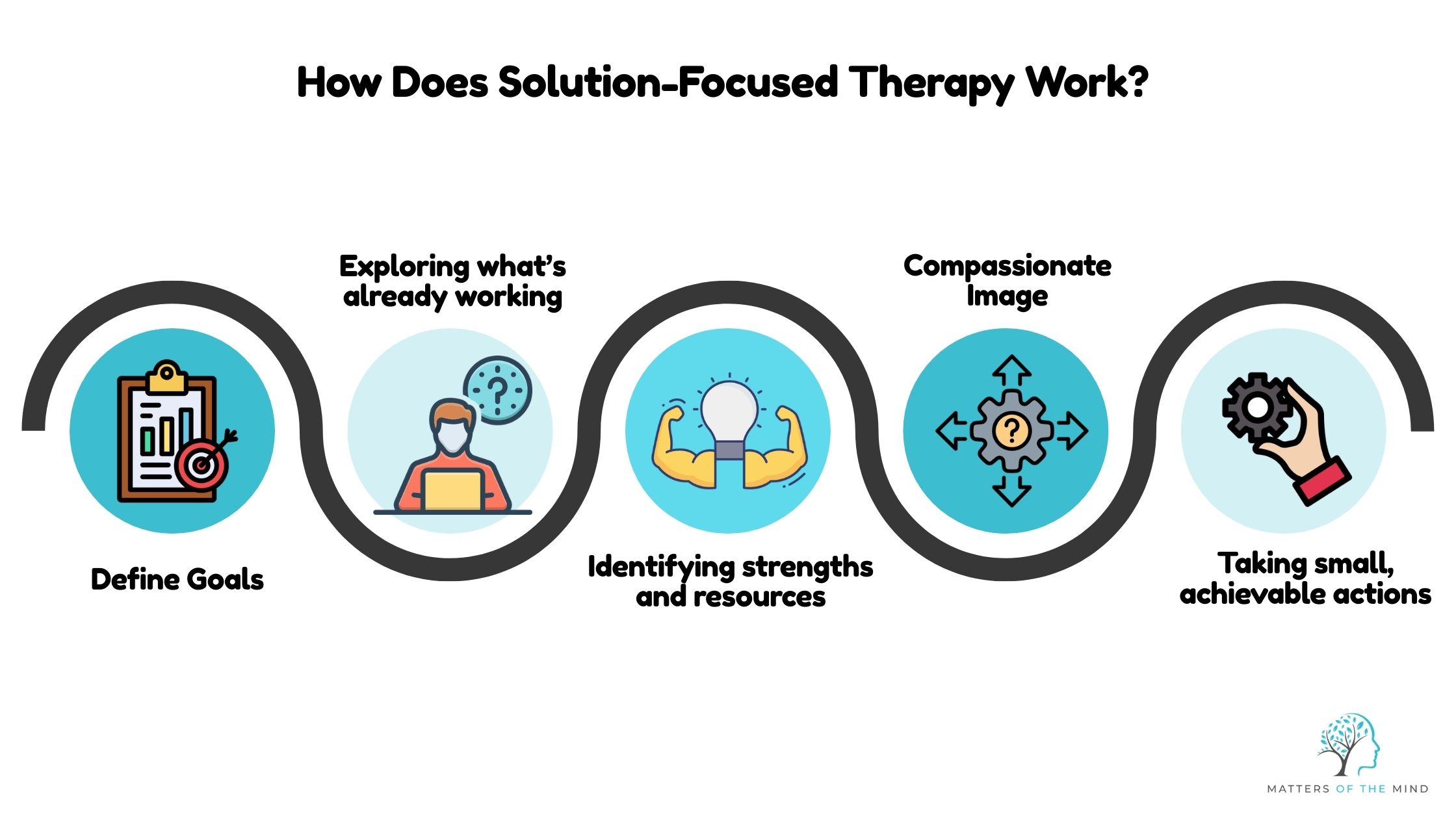
Solution-focused therapy typically involves short, structured sessions centred around clear and achievable goals. The process often includes:
How Does Solution-Focused Therapy Work

1. Defining what you want to achieve

This conversation begins with understanding what you want life to look like, even if the change feels small. SFT encourages you to imagine a better version of yourself where the challenge is lighter or more manageable. This vision becomes the foundation for all the progress.

2. Exploring what’s already working

Every difficult situation has moments where things feel slightly better. SFT highlights these expectations and helps you recognise what you’re doing in those moments, often without realising it. These existing strengths become building blocks for change.

3. Identifying strengths and resources

Whether it’s resilience, patience, determination, or support from others, solution-focused therapy encourages you to acknowledge the resources already part of your life. This shifts the focus from limitations to possibilities.

4. Compassionate Image

You may be invited to rate your current situation on a scale. This isn’t to judge your experience, but to help you see where you are today and what small steps can move you even half a point forward. These gentle shifts often lead to steady, meaningful growth.

5. Taking small, achievable actions

Changing within SFT doesn’t rely on big leaps. Instead, it focuses on simple, realistic actions that you can reply to right away. Over time, these small efforts create momentum and build a sense of control and confidence.

What Makes Solution-Focused Therapy Unique?

What Makes Solution-Focused Therapy Unique

1. Short-term and goal-driven

SFT is designed to create meaningful change in a relatively short time, making it ideal for individuals who prefer focused outcomes.

2. Strength-based approach

Solution-focused therapy doesn’t diagnose or label any problem; it emphasises your strengths and capabilities and helps you individually accordingly.

3. Future oriented

The focus of this therapy remains on possibilities like what can be improved, created or strengthened rather than replaying past experiences.

Who Can Benefit From Solution-Focused Therapy?

SFT can support individuals experiencing a wide range of concerns, including:
  • Stress and overwhelm
  • Anxiety
  • Relationship difficulties
  • Low mood
  • Self-confidence challenges
  • Work-related concerns
  • Personal growth and life transitions

Frequently Asked Questions (FAQs)

1. What is Solution-Focused Therapy?

Solution-focused therapy is a short-term therapeutic approach that helps individuals build solutions by focusing on their strengths, goals, and the future they want to create.

2. How does Solution-Focused Therapy differ from other therapies?

Unlike traditional therapies that explore past experiences in depth, SFT focuses on present strengths and future possibilities, helping you make practical, achievable changes.

3. Is Solution-Focused Therapy suitable for everyone?

SFT can benefit individuals facing stress, anxiety, low mood, relationship challenges, confidence issues, or life transitions. It is gentle, hopeful, and adaptable.

4. How many sessions do people usually need?

SFT is typically brief. Many individuals notice positive changes within a few sessions, although the number depends on your goals and personal needs.

5. What can I expect in a Solution-Focused Therapy session?

Sessions often include goal-setting, exploring what’s already working, identifying strengths, and using scaling questions to track progress and plan small, manageable steps.

6. Can I book a session with Dr Kavita for Solution-Focused Therapy?

Yes. Dr Kavita Deepak-Knights offers personalised psychological therapy at Matters of the Mind in Windsor, Berkshire. You can book a session to explore whether SFT is right for you.

Final Thoughts

Healing doesn’t always require revisiting every difficult memory or analysing the past in detail. Often, meaningful change begins by gently shifting your focus toward what is possible and taking small, intentional steps that move you forward.
Solution-focused therapy offers a hopeful, future-oriented approach that helps you reconnect with your strengths, resilience, and vision for a brighter tomorrow.

If you feel ready to take the next step toward clarity and emotional balance, you can book a personalised session with Dr Kavita Deepak-Knights, an experienced mental health psychologist and founder of Matters of the Mind. Her compassionate, personalised, and evidence-based psychological therapy services provide a supportive and empowering space to begin your healing journey.

Remember, the smallest step towards change can open the door to a better and healthier mental well-being.
Dr. Kavita Deepak-Knights
About the Author

Dr Kavita Deepak-Knights linkdin icon

With over 20 years of clinical experience, Dr Kavita brings a trusted and expert approach to mental health care. As the founder of Matters of the Mind and an Oxford-trained psychologist, she specialises in evidence-based therapies, including CBT, ACT, DBT, and EMDR, offering personalised support to help individuals understand their challenges and enhance their overall well-being.