
Some people can’t sit in a café without picking the seat facing the door. Others feel their pulse spike when a colleague’s tone changes slightly, or can’t fall asleep until they’ve checked the locks twice. None of this is about being careful. It’s what happens when a nervous system decides the danger never really passed.
This is hypervigilance, and it’s more common, and more misunderstood, than most people assume.
What Is Hypervigilance?
What is hypervigilance, actually? At its simplest, it’s a state where the brain and body stay switched on for threats that aren’t there. Not paranoia exactly, and not the normal caution most of us apply crossing a busy road. It’s involuntary. The nervous system has learned, usually the hard way, that staying alert is safer than relaxing, and it doesn’t easily unlearn that.
Worth saying plainly: hypervigilance disorder isn’t its own diagnosis in the UK’s clinical manuals. You won’t find it listed as a standalone condition. It shows up instead as a symptom inside other things, most often PTSD and anxiety disorders, which is part of why it goes unnamed for so long. People live with it for years assuming it’s just how they are.
Hypervigilance Symptoms
The symptoms don’t stay in one lane. They show up physically, mentally, and in how someone behaves, and they tend to blur into each other rather than arriving one at a time.
Physically, there’s the racing heart, the tight shoulders and jaw, a startle response that’s a beat too fast, and sleep that never quite lands properly because the mind won’t stand down. Mentally, it’s the constant background scanning, trouble focusing on anything except possible threats, a short fuse, and that low hum of dread with nothing specific attached to it.
Then there’s what people actually do about it, often without realising they’re doing it. Avoiding certain streets or situations. Sitting with a clear view of the exit, every time, without thinking about why. Checking the door is locked, then checking again five minutes later. Struggling to trust someone even when they’ve given no real reason not to be trusted.
One bad week can produce a couple of these. That’s normal. It’s when they stack up and start dictating how someone lives, where they sit, who they let close, that it stops being a rough patch and starts being something the nervous system needs actual help with.
Causes of Hypervigilance
Ask what causes hypervigilance and the honest answer is usually: repetition. The body learned danger was likely, through one bad experience or a hundred small ones, and adjusted accordingly.
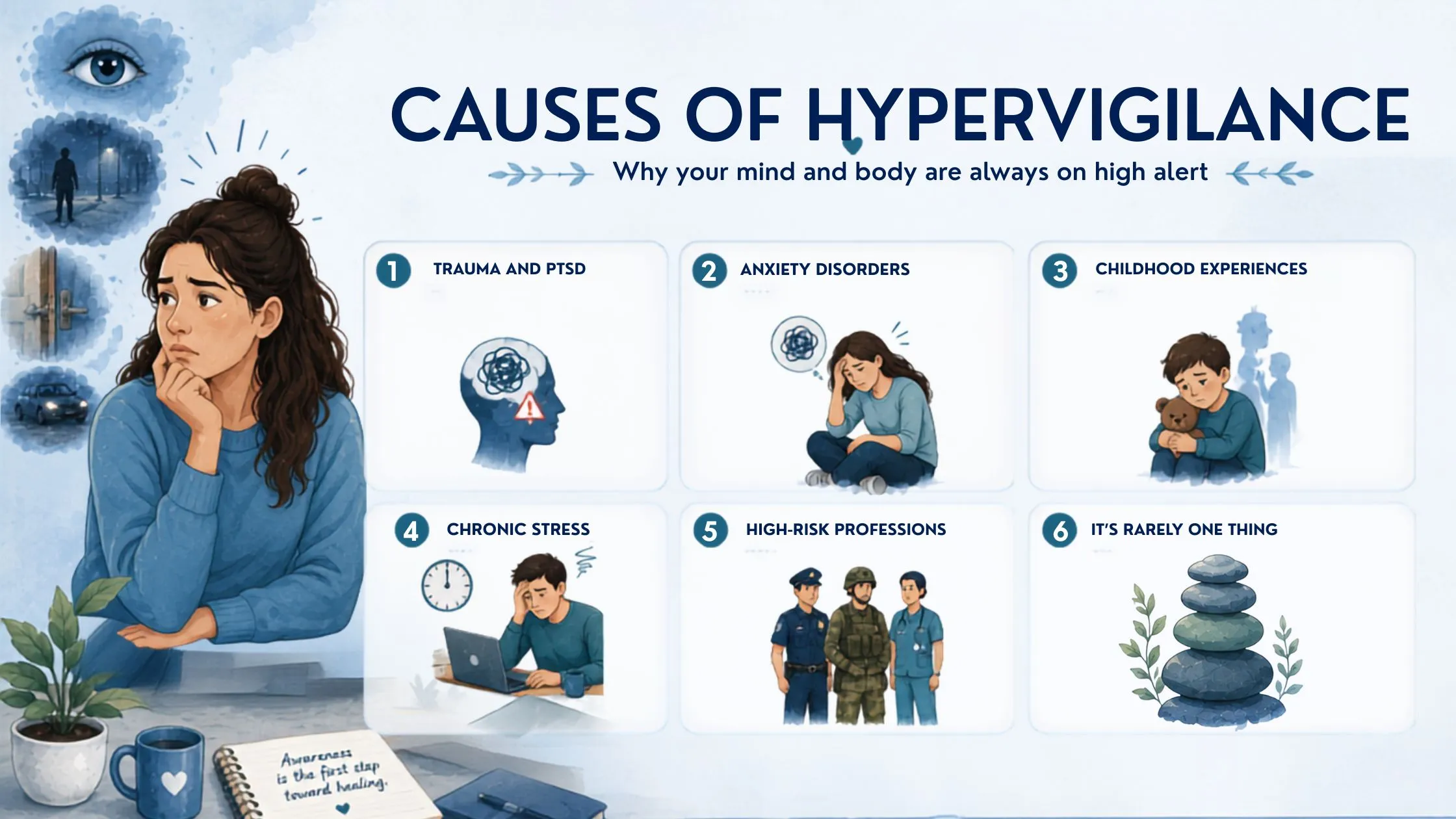
Trauma and PTSD sit at the top of the list, and they’re the best-researched cause by a distance. After something traumatic, the amygdala, the brain’s alarm system, can get stuck in an oversensitive state, firing off a fight-or-flight response at things that pose no actual threat.
Anxiety disorders play a similar role. Generalised anxiety, panic disorder, social anxiety, they all involve a system primed to expect the worst, and hypervigilance is often the physical shape that expectation takes.
Then there’s childhood. Kids who grow up somewhere unpredictable, whether that’s conflict at home, neglect, or a caregiver who was warm one day and volatile the next, often develop a nervous system wired for alertness that sticks around long after childhood ends.
Chronic stress does something similar over time, just more slowly. Years in a high-pressure job, an unstable financial situation, ongoing conflict of any kind, and the body eventually settles into semi-permanent alert as its new baseline.
And certain jobs carry the risk built in. Police officers, military personnel, emergency responders, people whose work regularly puts them near real danger tend to develop hypervigilance simply as an occupational consequence.
It’s almost never one thing. Usually it’s several of these stacked on top of each other, each one confirming to the nervous system that switching off isn’t safe.
Hypervigilance and Anxiety: How They’re Connected
Hypervigilance and anxiety aren’t the same thing, but they tend to travel together and make each other worse. Anxiety is anticipation. Hypervigilance is the body physically preparing for whatever’s being anticipated, staying tense, staying watchful, ready to react before there’s anything to react to.
That link matters for treatment. Address the anxiety underneath, and the hypervigilance often eases with it, rather than needing to be tackled as some entirely separate problem.
How Common Is This, Really?
More common than the public conversation suggests, partly because it hides inside other diagnoses rather than being named on its own. NHS England’s 2023/24 Adult Psychiatric Morbidity Survey found that 22.6% of adults who screened positive for PTSD reported arousal symptoms, sleep trouble, irritability, concentration problems, and hypervigilance among them. (Source: NHS England, Adult Psychiatric Morbidity Survey 2023/24.) That’s a lot of people whose nervous systems are quietly running hot, most of them without ever putting a name to it.
Need support?
If you think this might be you, speaking to a qualified mental health professional is a reasonable place to start. Matters of the Mind offers tailored psychological support for trauma, anxiety and related conditions.
If you’re in crisis, contact your GP, call NHS 111, or reach the Samaritans free on 116 123.
Treatment for Hypervigilance
Here’s the actually reassuring part: this responds to treatment. A nervous system that learned to stay braced can learn, slowly, that it’s allowed to stand down.
Cognitive Behavioural Therapy tends to be the starting point. It works by picking apart the thought patterns keeping the threat response switched on, and retraining the brain, gradually, to register safety when safety is actually present.
Where trauma is the root cause, EMDR (Eye Movement Desensitisation and Reprocessing) often does more. It helps the brain reprocess the memories that keep triggering a full alarm, so they stop landing with the same force.
Body-based work matters too, more than people expect. Grounding techniques, breathwork, anything that speaks to the physical symptoms directly rather than only the thoughts, can calm an overactive system in real time.
None of that means lifestyle is irrelevant. Sleep, cutting back on caffeine, moving your body regularly, these won’t fix hypervigilance by themselves, but they do lower the general stress load the nervous system is already working against.
And at a certain point, this is genuinely worth taking to a professional, particularly once it starts affecting sleep, relationships, or day-to-day functioning.
Dr Kavita Deepak-Knights, an Oxford-trained psychologist with over 20 years of clinical experience and founder of Matters of the Mind, works with exactly this using evidence-based approaches including CBT, ACT, DBT and EMDR, helping people understand what’s actually driving their hypervigilance and work through it at whatever pace suits them.
Final Thoughts
The role of integrative therapy in treating addiction lies in the ability to see the individual with personalised support. By combining different therapeutic approaches, it creates a space where healing can happen at every level, whether emotional, psychological or behavioural.
It’s learned. Which means, with the right support, it can be unlearned too.
If any of this reads uncomfortably close to your own experience, that’s worth sitting with rather than shrugging off. Naming it is usually the first real step toward it easing.
Ready to prioritise your mental health?
Connect with Dr Kavita Deepak-Knights to explore personalised care and navigate mental health challenges.
Frequently Asked Questions (FAQs)
1. What is an example of hypervigilance?
A common example is constantly scanning your surroundings for possible danger, even when you’re somewhere safe. You might always choose a seat facing the door, repeatedly check that your doors are locked, become unusually alert when someone raises their voice, or feel easily startled by sudden sounds.
2. What is the difference between anxiety and hypervigilance?
Anxiety is mainly about expecting something bad to happen, while hypervigilance is the constant state of being on guard for danger. They often overlap. For example, anxiety might make you worry that something will go wrong, while hypervigilance may have you constantly checking your surroundings for signs that it is about to happen.
3. Are hypervigilant people smart?
Hypervigilance does not mean someone is more intelligent. However, people who are hypervigilant may become very good at noticing small changes in their surroundings, such as changes in someone’s voice, facial expression or behaviour. This can look like heightened awareness, but it is usually linked to the nervous system being on high alert rather than intelligence.
4. What are some examples of hypervigilance?
Hypervigilance can look different from person to person. Examples include constantly checking doors or windows, sitting where you can see the exits, being easily startled by noises, closely monitoring other people’s behaviour, struggling to relax in unfamiliar places, feeling tense in crowds, or having difficulty sleeping because you are listening for potential threats.


