Think about the last time a stranger did something small for you. Maybe a driver waved you into a gap in traffic, or the person at the till let you go ahead because you only had one item. It took them four seconds. The good feeling it left behind can last a surprising part of the afternoon.
That feeling is worth looking at more closely, and World Kindness Day 2026 is a decent excuse to do it. It falls on Friday 13 November this year, and it has been marked on the same date since the World Kindness Movement held its first conference in Tokyo in 1997.
What the research says
The best-known UK figures come from the Mental Health Foundation. In April 2020, working with YouGov, it surveyed 4,246 adults for Mental Health Awareness Week. Around 63% said that when other people are kind to them, it has a positive effect on their mental health. The same share said that being kind to others helps their own mental health, and 48% said the same about being kind to themselves (Mental Health Foundation). The charity also describes kindness as an antidote to isolation, and links it to a stronger sense of belonging, confidence and optimism.
A survey only tells you what people believe, though, so it helps to look at experiments too. A 2018 systematic review and meta-analysis led by Oliver Scott Curry at Oxford pooled studies in which people were asked to perform kind acts, such as “random acts of kindness”, and measured their wellbeing afterwards. The overall effect was small to medium (Curry et al., Journal of Experimental Social Psychology, 2018).
That is a modest result, and it is better to say so plainly. Kindness is not a treatment for depression or anxiety, and nobody serious claims it is. But it costs nothing, has no side effects, and you can do it on a Tuesday morning without booking anything.
Why small acts seem to help
Nobody has pinned down exactly why, but a few explanations are plausible.
When you are low, stressed or stuck in a loop of worry, your attention turns inward and stays there. Doing something for another person pulls it outward for a while. It also gives you evidence, however small, that you can still be useful, which matters when your own opinion of yourself has taken a knock. And kindness tends to be returned. A text to a friend often becomes a conversation, and a conversation is the thing isolation takes away.
None of this needs to be dramatic. The Mental Health Foundation’s own briefing is clear that acts of kindness can range from telling someone you appreciate them to formal volunteering.
Kindness in the UK in numbers
Some UK figures show why small acts matter. In the government’s Community Life Survey for 2024/25, published in December 2025, 7% of adults in England said they feel lonely often or always, and 21% said they never feel lonely (GOV.UK, Community Life Survey 2024/25: loneliness). That leaves roughly seven in ten adults somewhere in between, feeling lonely now and then. A text or a chat over the fence can reach exactly those people.
Helping others is more mixed. In the same survey, 17% of adults volunteered formally with a group or organisation at least once a month, and 24% gave unpaid help to someone who was not a relative (GOV.UK, Community Life Survey 2024/25: volunteering). The Institute for Volunteering Research at the University of East Anglia describes formal volunteering in England as still at a historic low (IVR, UEA). More people help informally than formally, which is encouraging, because informal kindness needs no application form or rota.
Random Acts of Kindness Day 2026 and World Kindness Day
In the UK there are two dates people tend to mix up. Random Acts of Kindness Day fell on Tuesday 17 February 2026, in the middle of Random Acts of Kindness Week, and it comes round again every February. If you missed it, you have not missed much, because the idea works just as well in October or on a wet Wednesday in March.
World Kindness Day is the November one. This year it lands on a Friday, a few days before Anti-Bullying Week (16 to 20 November), so many schools and workplaces plan the two together (Awareness Days). If your workplace is doing something, join in. If it is not, nothing stops you starting something small yourself.
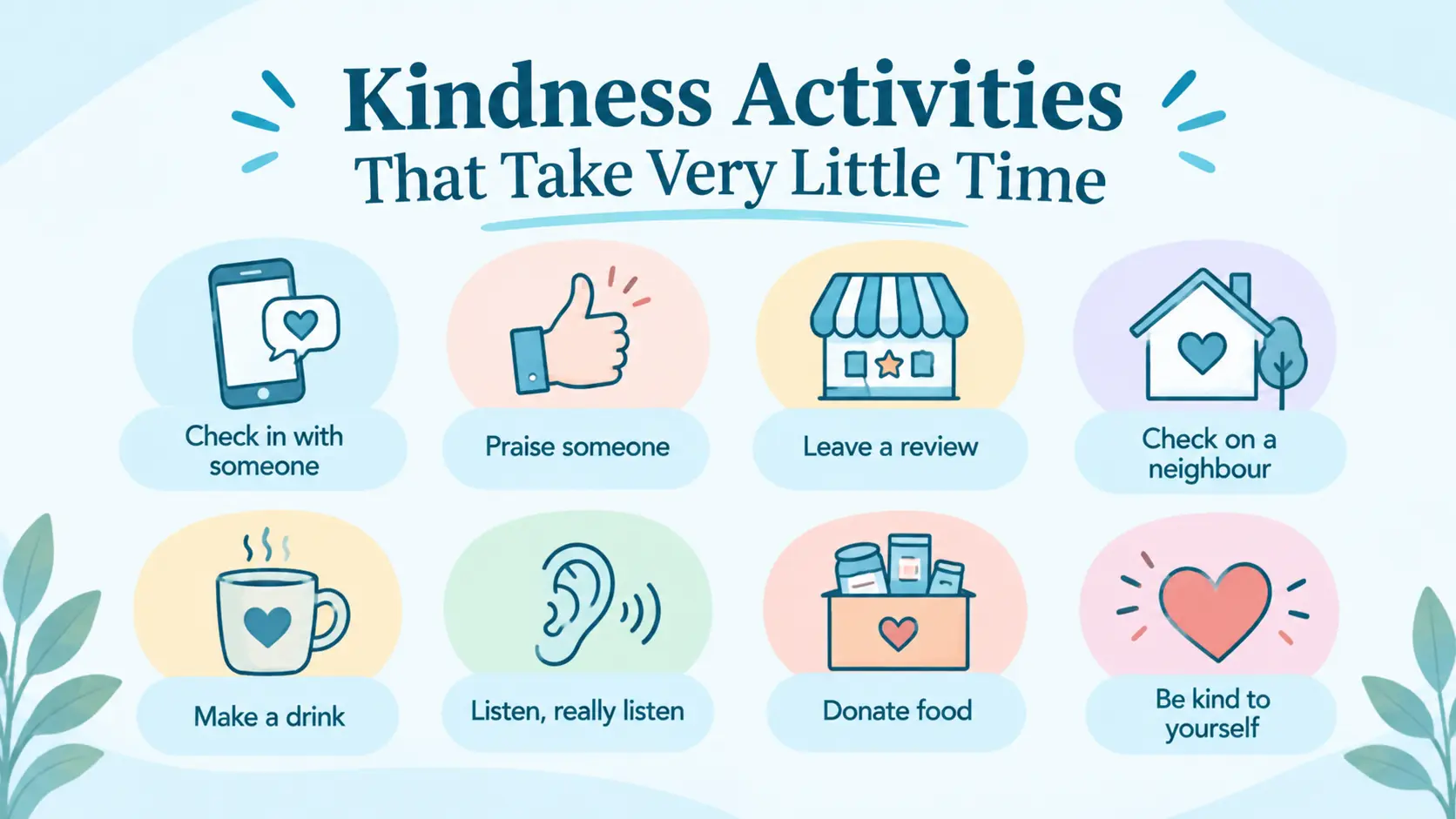
Kindness activities that take very little time
You do not need a plan, a budget or a spare weekend. Some ideas that fit into an ordinary day:
-
- Text someone you have been meaning to contact, with no agenda beyond “I was thinking of you”.
- Tell a colleague exactly what they did well this week, rather than just “good job”.
- Leave a proper review for a small local business you like.
- Check in on a neighbour who lives alone. The dark evenings make this one count for more in November.
- Make a drink for whoever in your house never gets one made for them.
- Put your phone face down during a conversation and actually listen.
- Give to a food bank, or pick up something extra for the collection box at the supermarket.
- Stop the running commentary the next time you make a mistake, and talk to yourself the way you would talk to a friend.
That last one is not a joke. Almost half of the people in the Mental Health Foundation survey said being kind to themselves helped their mental health, and it is the kind act people most often skip.
When kindness is not the answer
There is a version of “being kind” that does not help at all. If you are saying yes to everything because you are afraid of disappointing people, or giving until you are exhausted, that is closer to people-pleasing, and it can leave you feeling worse. The Mental Health Foundation’s briefing notes that our motivation for helping others influences how much it benefits our wellbeing. Kindness you choose tends to feel different from kindness you feel obliged to perform.
It also has limits. If low mood, anxiety, poor sleep or the kind of mental fog that makes everything harder has gone on for more than a couple of weeks, kindness is a good habit but not a replacement for proper support. A GP is a sensible first stop. Talking therapy can help too, particularly when stress or worry sits underneath it all.
For anyone in Berkshire, Dr Kavita Deepak-Knights is a Chartered Clinical Psychologist who runs Matters of the Mind in Windsor. She has more than 20 years of experience, including time in the NHS, and works with adults using approaches such as CBT, DBT and EMDR. You do not need a diagnosis, or the right words, to get in touch.
A small thing to try on 13 November
Pick one item from the list above and do it on World Kindness Day. Then, later in the evening, check whether your afternoon felt any different from usual. It might not. If it did, you have a free habit to keep.
Ready to prioritise your mental health?
Frequently Asked Questions (FAQs)
1. Can grief cause depression or anxiety?
2. How long does grief last?
3. Is it normal to feel nothing after someone dies?
4. What are some simple acts of kindness you can do every day?
You can check on a friend, compliment someone, help a neighbour, listen without distractions, donate to a food bank or offer someone a helping hand.
5. What is the difference between kindness and people-pleasing?
Kindness comes from a genuine willingness to help, while people-pleasing often involves seeking approval or avoiding conflict. Healthy kindness also means respecting your own needs and boundaries.